
What “Hot and Cold Numbers” Really Mean
“Hot” and “cold” numbers are the most popular — and most misunderstood — statistics in the lottery world. This guide explains exactly what they are, how we calculate them, and the one thing they absolutely cannot do.
What the terms mean
A hot number is one that has been drawn more often than average over a chosen period. A cold number is one that has been drawn less often, or not at all. That is the entire definition. It is a description of the past — a tally — and nothing more.
How we calculate them
For each prize category — last-two, front-three, last-three — we count how many times every possible number has appeared as a winner across our archive of recorded draws, then rank them. The numbers at the top of the count are “hot”; those at the bottom are “cold”. You can see the live ranking, plus a heat grid and per-number trends, on our statistics page.
Why the differences are normal randomness
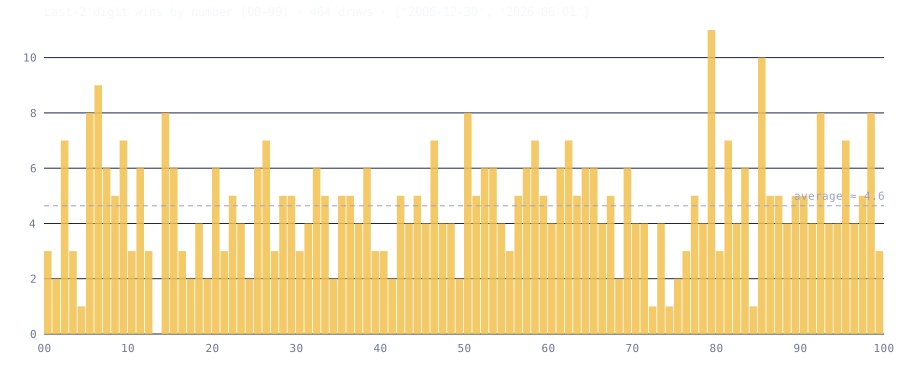
Look at the chart and you will see the bars cluster around the average, with some a little higher and some a little lower. Over hundreds of draws, the most-drawn last-two number has appeared only a handful more times than the average, and the spread has no pattern. This is exactly what random variation looks like: in any fair process, some outcomes get slightly ahead and others fall slightly behind, purely by chance. The gaps are noise, not signal.
The mistake almost everyone makes
The temptation is to treat hot numbers as “on a streak” (so back them) or cold numbers as “due” (so back them too). Both are versions of the same error. Because every draw is independent, a number’s past frequency has zero influence on the next draw. A hot number is not more likely to come up again, and a cold number is not owed an appearance. We explain the underlying maths in Why You Can’t Predict Lottery Numbers.
So are the stats useless?
Not at all — they are just for the right job. Frequency stats are genuinely interesting as a record: they let you see how an honest random process plays out over 20 years, settle arguments about which number has actually come up most, and explore the data behind the lottery. They satisfy curiosity. What they cannot do is tell you what is coming next. Use them that way and they are a great tool; use them as a prediction and they will only cost you money.
Explore responsibly
Dig into the numbers on the statistics page and look up any number’s full history in the number search. If choosing numbers ever starts to feel like more than fun, our Responsible Play page has guidance and support resources.
What “Hot and Cold Numbers” Really Mean
“Hot” and “cold” numbers are the most popular — and most misunderstood — statistics in the lottery world. This guide explains exactly what they are, how we calculate them, and the one thing they absolutely cannot do.
What the terms mean
A hot number is one that has been drawn more often than average over a chosen period. A cold number is one that has been drawn less often, or not at all. That is the entire definition. It is a description of the past — a tally — and nothing more.
How we calculate them
For each prize category — last-two, front-three, last-three — we count how many times every possible number has appeared as a winner across our archive of recorded draws, then rank them. The numbers at the top of the count are “hot”; those at the bottom are “cold”. You can see the live ranking, plus a heat grid and per-number trends, on our statistics page.
Why the differences are normal randomness
Look at the chart and you will see the bars cluster around the average, with some a little higher and some a little lower. Over hundreds of draws, the most-drawn last-two number has appeared only a handful more times than the average, and the spread has no pattern. This is exactly what random variation looks like: in any fair process, some outcomes get slightly ahead and others fall slightly behind, purely by chance. The gaps are noise, not signal.
The mistake almost everyone makes
The temptation is to treat hot numbers as “on a streak” (so back them) or cold numbers as “due” (so back them too). Both are versions of the same error. Because every draw is independent, a number’s past frequency has zero influence on the next draw. A hot number is not more likely to come up again, and a cold number is not owed an appearance. We explain the underlying maths in Why You Can’t Predict Lottery Numbers.
So are the stats useless?
Not at all — they are just for the right job. Frequency stats are genuinely interesting as a record: they let you see how an honest random process plays out over 20 years, settle arguments about which number has actually come up most, and explore the data behind the lottery. They satisfy curiosity. What they cannot do is tell you what is coming next. Use them that way and they are a great tool; use them as a prediction and they will only cost you money.
Explore responsibly
Dig into the numbers on the statistics page and look up any number’s full history in the number search. If choosing numbers ever starts to feel like more than fun, our Responsible Play page has guidance and support resources.