
Why You Can’t Predict Thai Lottery Numbers
Hot numbers, “due” numbers, lucky dreams and paid “sure-win” systems all promise the same thing: a way to guess the next Thai Government Lottery result. None of them work, and the reason is simple mathematics rather than opinion. Here is the plain-language explanation.
Every draw starts from zero
The Thai Government Lottery is a game of pure chance. On each draw day the winning numbers are selected at random, and the machine has no memory of any earlier draw. A number that came up last month is neither “used up” nor “warmed up” — it simply has the same chance as every other number, every single time. Statisticians call this independence: each draw is a fresh event, unaffected by the ones before it.
This is the single most important idea on this page. Once you accept that draws are independent, every prediction system collapses, because they all rely on the past somehow influencing the future. It cannot.
The “due number” trap
Suppose a particular last-two-digit number has not appeared for a long time. It feels like it is “due” — surely its turn is coming? This feeling is so common that it has a name: the gambler’s fallacy. The number is not due. It has exactly the same chance in the next draw as it did in the last one, regardless of how long the gap has been. A coin that lands heads ten times in a row is still a 50/50 coin on the eleventh toss; the coin does not know it “owes” you a tails.
The mirror image is just as wrong: believing a recent winner is now “hot” and likely to repeat. Neither a long absence nor a recent win changes the odds at all.
What “hot” and “cold” numbers really are
Frequency statistics are real and interesting — they are an honest record of what has already happened. But they describe the past; they do not forecast the future. Over a large number of draws, a fair lottery produces a roughly even spread, with small bumps and dips that are simply normal random variation. The chart below shows how often each last-two-digit number (00–99) has won the last-two prize across the full archive on this site.
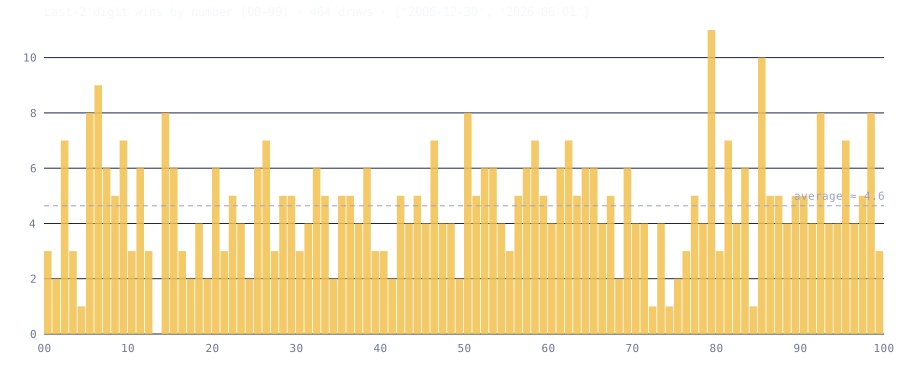
Notice there is no meaningful pattern: the tallest and shortest bars differ by only a handful of wins out of hundreds of draws, and they are scattered with no structure. A “hot” number is just one that happens to sit slightly above the average so far. That tells you nothing about the next draw. You can explore the same data yourself on our statistics page and look up any specific number in the number search.
Your real odds, tier by tier
It helps to see the actual numbers. For any single six-digit ticket:
- First prize — your exact six digits must match one specific number out of a million, so the chance is roughly 1 in 1,000,000.
- Last two digits — there are 100 possible pairs (00–99), so about 1 in 100. This is why the last-two prize, at ฿2,000, is the one most people ever win.
- Last three or front three — each three-digit number is 1 in 1,000; because two numbers are drawn in each of those tiers, your chance of matching one is about 1 in 500.
These odds are fixed by how the draw works. No statistic, system or ritual shifts them by even a fraction. We break every tier down in Understanding Lottery Odds.
Why buying more tickets barely moves the needle
Buying additional tickets does increase your absolute chance — but from almost nothing to slightly more than almost nothing. Ten different six-digit numbers raise your first-prize chance to about 10 in 1,000,000, which is still effectively zero, while your spending rises in a straight line. The lottery is designed so that, on average, players receive back less than they put in; that gap is what funds the prize pool and public programmes. Spending more does not change that arithmetic in your favour.
Dreams, licence plates and number sellers
Choosing numbers from a dream, a monk’s blessing, a licence plate or a date is a cherished part of Thai lottery culture, and there is nothing wrong with playing a number that means something to you for fun. Just be clear about what it is: a personal choice, not a method that improves your odds. Any number is as likely as any other.
Be far more cautious with anyone who sells predictions, “leaked” numbers or guaranteed systems. They cannot deliver what they promise — the maths makes that impossible — and paying for it only guarantees a loss before the draw even happens. If a seller could really predict results, they would have no reason to sell them to you.
How to use our statistics the right way
So what are the tools on this site good for? Plenty — as long as you treat them as a record, not a crystal ball. Use the results archive to look up past draws, the number search to see a number’s history, the statistics to satisfy curiosity about the long-term spread, and the Did I Win? checker to confirm a ticket you already hold. They make a genuinely random game easy to explore and verify. They do not, and cannot, tell you what is coming next.
If playing ever stops feeling like harmless fun, please read our Responsible Play guidance, which includes support resources in Thailand.
Frequently asked questions
Are some Thai lottery numbers luckier than others?
If a number hasn’t appeared in a long time, is it due?
Can anyone predict the Thai lottery?
Why You Can’t Predict Thai Lottery Numbers
Hot numbers, “due” numbers, lucky dreams and paid “sure-win” systems all promise the same thing: a way to guess the next Thai Government Lottery result. None of them work, and the reason is simple mathematics rather than opinion. Here is the plain-language explanation.
Every draw starts from zero
The Thai Government Lottery is a game of pure chance. On each draw day the winning numbers are selected at random, and the machine has no memory of any earlier draw. A number that came up last month is neither “used up” nor “warmed up” — it simply has the same chance as every other number, every single time. Statisticians call this independence: each draw is a fresh event, unaffected by the ones before it.
This is the single most important idea on this page. Once you accept that draws are independent, every prediction system collapses, because they all rely on the past somehow influencing the future. It cannot.
The “due number” trap
Suppose a particular last-two-digit number has not appeared for a long time. It feels like it is “due” — surely its turn is coming? This feeling is so common that it has a name: the gambler’s fallacy. The number is not due. It has exactly the same chance in the next draw as it did in the last one, regardless of how long the gap has been. A coin that lands heads ten times in a row is still a 50/50 coin on the eleventh toss; the coin does not know it “owes” you a tails.
The mirror image is just as wrong: believing a recent winner is now “hot” and likely to repeat. Neither a long absence nor a recent win changes the odds at all.
What “hot” and “cold” numbers really are
Frequency statistics are real and interesting — they are an honest record of what has already happened. But they describe the past; they do not forecast the future. Over a large number of draws, a fair lottery produces a roughly even spread, with small bumps and dips that are simply normal random variation. The chart below shows how often each last-two-digit number (00–99) has won the last-two prize across the full archive on this site.
Notice there is no meaningful pattern: the tallest and shortest bars differ by only a handful of wins out of hundreds of draws, and they are scattered with no structure. A “hot” number is just one that happens to sit slightly above the average so far. That tells you nothing about the next draw. You can explore the same data yourself on our statistics page and look up any specific number in the number search.
Your real odds, tier by tier
It helps to see the actual numbers. For any single six-digit ticket:
- First prize — your exact six digits must match one specific number out of a million, so the chance is roughly 1 in 1,000,000.
- Last two digits — there are 100 possible pairs (00–99), so about 1 in 100. This is why the last-two prize, at ฿2,000, is the one most people ever win.
- Last three or front three — each three-digit number is 1 in 1,000; because two numbers are drawn in each of those tiers, your chance of matching one is about 1 in 500.
These odds are fixed by how the draw works. No statistic, system or ritual shifts them by even a fraction. We break every tier down in Understanding Lottery Odds.
Why buying more tickets barely moves the needle
Buying additional tickets does increase your absolute chance — but from almost nothing to slightly more than almost nothing. Ten different six-digit numbers raise your first-prize chance to about 10 in 1,000,000, which is still effectively zero, while your spending rises in a straight line. The lottery is designed so that, on average, players receive back less than they put in; that gap is what funds the prize pool and public programmes. Spending more does not change that arithmetic in your favour.
Dreams, licence plates and number sellers
Choosing numbers from a dream, a monk’s blessing, a licence plate or a date is a cherished part of Thai lottery culture, and there is nothing wrong with playing a number that means something to you for fun. Just be clear about what it is: a personal choice, not a method that improves your odds. Any number is as likely as any other.
Be far more cautious with anyone who sells predictions, “leaked” numbers or guaranteed systems. They cannot deliver what they promise — the maths makes that impossible — and paying for it only guarantees a loss before the draw even happens. If a seller could really predict results, they would have no reason to sell them to you.
How to use our statistics the right way
So what are the tools on this site good for? Plenty — as long as you treat them as a record, not a crystal ball. Use the results archive to look up past draws, the number search to see a number’s history, the statistics to satisfy curiosity about the long-term spread, and the Did I Win? checker to confirm a ticket you already hold. They make a genuinely random game easy to explore and verify. They do not, and cannot, tell you what is coming next.
If playing ever stops feeling like harmless fun, please read our Responsible Play guidance, which includes support resources in Thailand.