
20 Years of Thai Lottery Data: What the Record Shows
One thing that makes this site useful is depth: an archive of 464 recorded Government Lottery draws stretching from December 2006 to mid-2026 — close to 20 years. This guide looks at what that long-term record actually shows, using our own data. The short version: it looks random, and that is exactly the point.
What’s in the archive
The dataset covers 464 draws across roughly two decades. In a typical year there are 24 draws (two a month), and the chart below shows the count year by year.
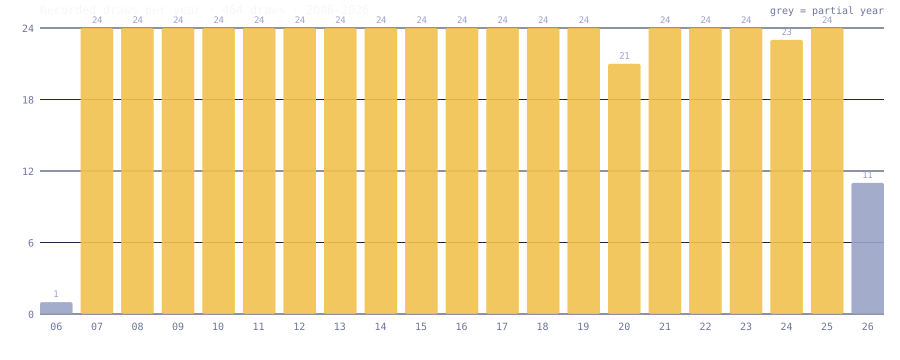
The first and last bars are partial — the archive begins with a 30 December 2006 draw and runs to mid-2026 — and 2020 dips to 21 draws. We base our statistics on these actual recorded draws rather than assuming a perfect two-per-month, which keeps the frequencies honest.
The front-three prize starts in 2015
A data quirk worth knowing: the front-three prize only exists from 1 September 2015 onward, so our archive holds front-three results for 256 draws rather than all 464. Last-three and last-two figures, by contrast, run the full span. This is why front-three frequencies are drawn from a smaller sample.
What 20 years of last-two digits looks like
The last-two-digit prize is the richest part of the record — one winning pair every draw, for 464 draws. If the lottery is fair, every pair from 00 to 99 should appear roughly the same number of times over a long span, with only chance-driven wobble. That is what we see: across the archive the average pair has won about 4–5 times, the most-drawn pair has appeared around 11 times, and at the other extreme some pairs have come up only once. One pair has not appeared as a last-two winner at all in the recorded draws.
Doesn’t a missing number prove a pattern?
It’s the opposite. With 100 possible pairs and 464 draws, pure chance guarantees that some numbers race ahead while others lag or get skipped entirely — that scatter is the signature of randomness, not evidence against it. If every number had appeared exactly the same number of times, that would be suspicious. A number that has never come up is not “cold” or “avoided”; it has the same chance as any other in the next draw. We unpack this in What Hot and Cold Numbers Really Mean.
The honest takeaway
Twenty years of data is a wonderful thing to explore, but it does not reveal a system, because there isn’t one. The value of a long record is that it lets you see randomness clearly — the even-ish spread, the meaningless streaks, the gaps — and understand why no past result predicts a future one. Browse it all in the results archive and the statistics page, search any number’s history in number search, and read how we compile the data on our About page.
20 Years of Thai Lottery Data: What the Record Shows
One thing that makes this site useful is depth: an archive of 464 recorded Government Lottery draws stretching from December 2006 to mid-2026 — close to 20 years. This guide looks at what that long-term record actually shows, using our own data. The short version: it looks random, and that is exactly the point.
What’s in the archive
The dataset covers 464 draws across roughly two decades. In a typical year there are 24 draws (two a month), and the chart below shows the count year by year.
The first and last bars are partial — the archive begins with a 30 December 2006 draw and runs to mid-2026 — and 2020 dips to 21 draws. We base our statistics on these actual recorded draws rather than assuming a perfect two-per-month, which keeps the frequencies honest.
The front-three prize starts in 2015
A data quirk worth knowing: the front-three prize only exists from 1 September 2015 onward, so our archive holds front-three results for 256 draws rather than all 464. Last-three and last-two figures, by contrast, run the full span. This is why front-three frequencies are drawn from a smaller sample.
What 20 years of last-two digits looks like
The last-two-digit prize is the richest part of the record — one winning pair every draw, for 464 draws. If the lottery is fair, every pair from 00 to 99 should appear roughly the same number of times over a long span, with only chance-driven wobble. That is what we see: across the archive the average pair has won about 4–5 times, the most-drawn pair has appeared around 11 times, and at the other extreme some pairs have come up only once. One pair has not appeared as a last-two winner at all in the recorded draws.
Doesn’t a missing number prove a pattern?
It’s the opposite. With 100 possible pairs and 464 draws, pure chance guarantees that some numbers race ahead while others lag or get skipped entirely — that scatter is the signature of randomness, not evidence against it. If every number had appeared exactly the same number of times, that would be suspicious. A number that has never come up is not “cold” or “avoided”; it has the same chance as any other in the next draw. We unpack this in What Hot and Cold Numbers Really Mean.
The honest takeaway
Twenty years of data is a wonderful thing to explore, but it does not reveal a system, because there isn’t one. The value of a long record is that it lets you see randomness clearly — the even-ish spread, the meaningless streaks, the gaps — and understand why no past result predicts a future one. Browse it all in the results archive and the statistics page, search any number’s history in number search, and read how we compile the data on our About page.